
Finding the Right Tools: The Real Solution to Labor Shortages?
If you're a contractor, landscaper, electrician, or plumber, you've likely felt the squeeze. Demand for construction and infrastructure work keeps climbing, but there aren't enough skilled tradespeople to meet it. And if you're waiting for the workforce pipeline to catch up, you may be waiting a long time.
The real question isn't just where all the workers are, it's how do you keep your business moving when you're already running lean? The answer may have less to do with hiring and more to do with the tools you're bringing to the job.
Problem: A Labor Shortage
Across the board, we are seeing a labor shortage in every trade industry, while the demand is staying the same (if not growing!). According to CCE, by 2031, 41% of the construction workforce is expected to retire. On the other hand, only 10% of construction workers are younger than 25. Electricians face a similar problem: almost 30% of electricians are near retirement age, but CLIMB states that the rate of retirement far outpaces the rate of apprentices becoming journeymen. Plumbers may face the biggest labor shortage, as Revenue Memo states that by 2027, their industry is expected to have a deficit of 550,000 workers. Up to 92% of landscapers cite labor shortages as their biggest challenge. With society placing greater emphasis on four-year college degrees, what can be done?
Digging Deeper: The Real Problem
Of course, the labor shortage is a big problem in our industry, but how does this problem affect you? Let’s say you have 3 jobs lined up next week that require trenching. One requires an 80-foot trench, one a 150-foot trench, and the third a 120-foot trench. Let’s say it takes 3 crew members 4 hours to trench 100 feet. Let’s break that down:
-
4 hours per 100 feet
-
80 ft + 150 ft + 120 ft = 350 ft
-
(350 ft ÷ 100 ft) × 4 hours = 14 hours spent trenching
For irrigation installers, landscape lighting contractors, fiber and telecom crews, and electricians pulling conduit through tight residential backyards, this is a weekly reality. When your crew is already stretched thin, losing 14 hours to hand digging isn't a minor inefficiency; it's a serious profitability problem.
"Just Use a Walk-Behind Trencher" - Here's the Problem with That
Walk-behind trenchers are great in wide open spaces. When you’re doing residential landscaping jobs, backyard irrigation repairs, and tight utility installations, they frequently involve fenced or gated access that large equipment can't fit through, existing landscaping that can't be torn up or driven over, slopes and confined areas, and steep rental costs that eat into your margins before the job even starts. Sometimes, it can feel like hand-digging is your easiest and only choice, but it doesn’t have to be.
The Solutions: The Right Tools
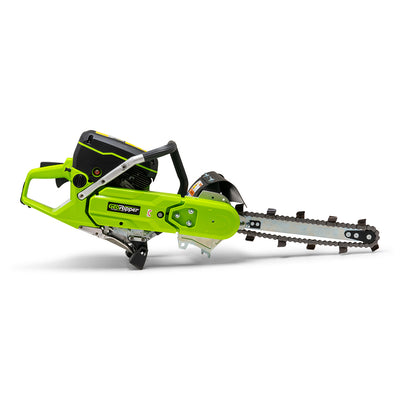
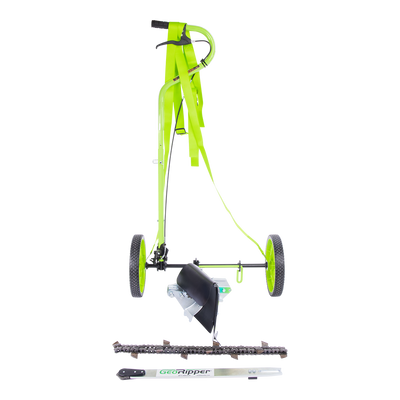
Instead of losing your crew, that’s already spread thin, to hand-digging consider using compact tools that let one-person trench in a fraction of the time. With tools like the GeoRipper® one operator can trench 100 feet in 30 minutes. Instead of 14 hours, you could have all your trenching done in less than 2 hours. It goes without saying that that’s a pretty big improvement.
One operator, no trailer, no big machine. Just a compact tool that takes some of the pressure off your crew, shortens job times, and keeps your crew pushing. Ready to do the math and see just how much time and money GeoRipper can save you? Use our potential profit calculator to see for yourself today!