Installing Utilities Under Concrete (Without Trenching!)
As a contractor, you’re no stranger to trenching. Whether you’re digging with a full-sized trencher, a handheld trencher (hint: GeoRipper®), or even digging by hand (yikes), we’ve all trenched a time or two. We also know that no matter how good your tools are, sometimes trenching creates more mess and work than you want to do.
Let’s imagine a scenario many of us are familiar with. You’ve been hired to install utilities or a pipe for a local homeowner. You’re getting ready to give the customer a quote but realize that there is a sidewalk you have to bore under for your installation. Now you’re faced with a challenge.
Option 1: Cut and Remove Concrete
After you cut and remove a whole slab of concrete, you are able to do your installation and pour new concrete to repair the sidewalk. In theory, this sounds like a hassle, but it’s not the end of the world. Other jobs present bigger, more complicated problems. But it still creates a challenge. This three-foot-wide piece of concrete is adding hundreds (if not thousands) of dollars of materials and labor to your job. Now, your quote is looking a lot steeper. That or you can let it eat into your profits – something no one wants.
Everything about this is assuming the homeowner is even okay with the price increase AND a section of their sidewalk standing out.
Option 2: Utilize Horizontal Auger / Bore
Contractors often use horizontal augers or boring equipment to install utilities under sidewalks without removing and replacing the concrete. However, many of these machines are large and expensive for smaller jobs. They are often designed to bore larger diameter holes than needed for small utility lines, which can create unnecessary disturbance or stability concerns. Some drilling systems also rely on drilling fluids that can leave behind a muddy jobsite and require additional cleanup and maintenance.
Option 3: Hard Labor and Brute-Force
Boring underneath a sidewalk with brute-force methods—like driving a piece of PVC pipe with a sledgehammer or trying to wash a hole through the soil with a garden hose—is a common DIY approach, but it’s rarely the best solution. While these techniques may appear simple and inexpensive, they are difficult to control and often create more problems than they solve. Hammering PVC through compacted soil or roots can easily crack the pipe, stall progress, or damage the surrounding ground, while water jetting can erode the soil beneath the concrete, leading to voids that may eventually cause the sidewalk to settle or crack. A quick search online will show plenty of claims that a PVC pipe, a hammer, and a hose are all you need, and you’ll also find smaller water-based boring tools marketed for this purpose—but even those often create holes far larger than necessary for irrigation or utility lines. In practice, these methods can be slow, messy, and unpredictable, making them a poor choice when precision, speed, and protecting the surrounding surface are important.
Option 4: Portable Horizontal Auger / MicroBore
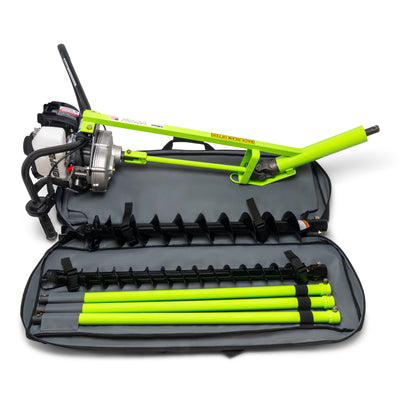
For contractors looking for a cleaner, more controlled way to get under a sidewalk, a portable horizontal auger—or microbore—may be the solution. Tools like the SiBore Drill are designed specifically for small utility crossings. Instead of cutting concrete, bringing in large boring equipment, or relying on brute-force methods, the SiBore Drill allows contractors to bore a precise hole just large enough for irrigation lines, conduit, or small pipe. This targeted approach minimizes disturbance to the surrounding soil and helps avoid the unnecessary mess often associated with other methods. Because the tool operates mechanically rather than relying on water or drilling fluids, contractors can also avoid muddy jobsites and the risk of washing out soil beneath the slab. The result is a faster, cleaner installation that helps protect the sidewalk—and your profit margin—while keeping the job simple and efficient.
To check out SiBore Drill Click Here