
Water Jet vs. Dry Auger Boring Under: What Contractors Need to Know
More contractors are searching for answers about water jet boring vs. dry auger methods before they commit to a technique. And the reason is almost always the same: they're worried about what happens above the bore hole once they're gone.
That concern is valid. Let's break down the risks clearly so you can make the right call for your next job.
The Appeal of Water Jet Boring (And Why It Falls Short)
Using a hose, pressure washer, or wet boring tool to wash out a path under a sidewalk or driveway is common. It's low-cost, accessible, and, on the surface, looks like a fast solution.
The problem is what you can't see.
Risk 1: Ground Collapse Under the Surface
This is the one contractors lose sleep over. When you use water to bore under a driveway or sidewalk, you're not just moving soil — you're saturating it. According to an article by Turf & Rec, in sandy or loose soils, that saturation destroys the structural integrity of the ground above the bore path. The pipe or conduit has to go in immediately, and even then, the void left behind can continue to shift and settle.
The result: a cracked sidewalk, a sunken driveway section, and an angry homeowner.
The risk isn't theoretical. It's why queries like "will water boring collapse my sidewalk" are showing up so often. Contractors have seen it happen, or they've heard enough horror stories to start asking questions before the job.
Risk 2: Debris Injury on the Job
In an article on ForConstructionPros.com, Mike Hale points out that as pressurized water dislodges soil and rocks, that debris has to go somewhere… and it usually comes back out fast. Flying debris during wet boring is a documented cause of crew injuries. Now you're dealing with a safety incident, a muddy disaster, and you still have a bore to finish.
Not a great afternoon.
Why Dry Horizontal Auger Boring Is the Safer Call
A dry flighted auger works differently at a mechanical level, and that difference matters when the surface above the bore hole can't afford to move.
Instead of washing soil away and leaving a saturated void, a dry auger mechanically pulls soil out of the bore hole in a controlled, continuous process. The auger flights bring material back toward the operator as the tool advances. That means:
-
No water saturation weakening the soil structure above
-
No unsupported void left behind for the surface to drop into
-
Less pressure and disturbance on the ground above the bore path, as per Live to Plant
M’One Drilling states that this makes dry boring particularly well-suited for the soil types that are most vulnerable to collapse — loose sandy soil, soft fill, and clay-heavy ground. In fact, for softer soils, the decreased pressure of a dry auger is an advantage, not a limitation.
The only real obstacle with dry horizontal auger boring is hitting a rock the auger can't drill through, in which case, you simply adjust your bore path and continue.
The Right Tool for Under-Driveway and Under-Sidewalk Work
If you've landed here because you're trying to avoid the headaches that come with wet boring, the washouts, the collapses, the cleanup, the SiBore™ Drill was built for exactly this situation.
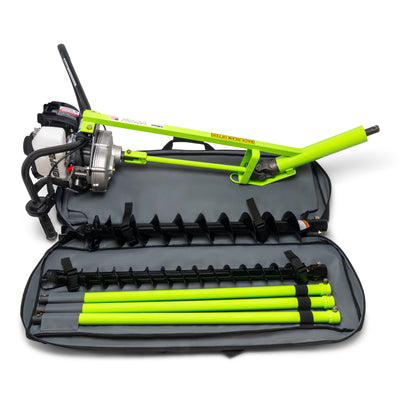
It's a compact, portable horizontal auger that bores under sidewalks, driveways, and hardscaped surfaces without requiring water. No mud. No saturation. No void left behind to settle.
What sets it apart:
-
Available boring diameters from 1" microbore up to 8" auger
-
Gas-powered (Honda 4-cycle) or battery-powered (Makita 40V max XGT) motor options
-
Fully self-contained — no trailer required
-
Water-free operation keeps jobsites clean and restores faster
-
Proven performance in clay and dense soils
One operator. No water hookup. No restoration nightmare.
If you're ready to stop guessing whether the surface above your bore is going to hold, click here.